:max_bytes(150000):strip_icc():focal(329x0:331x2):format(webp)/burt-reynolds-17-2-6229c592e4c140318dcab0448a87370e.jpg)


Burgas Бургас Bourgas | |
|---|---|
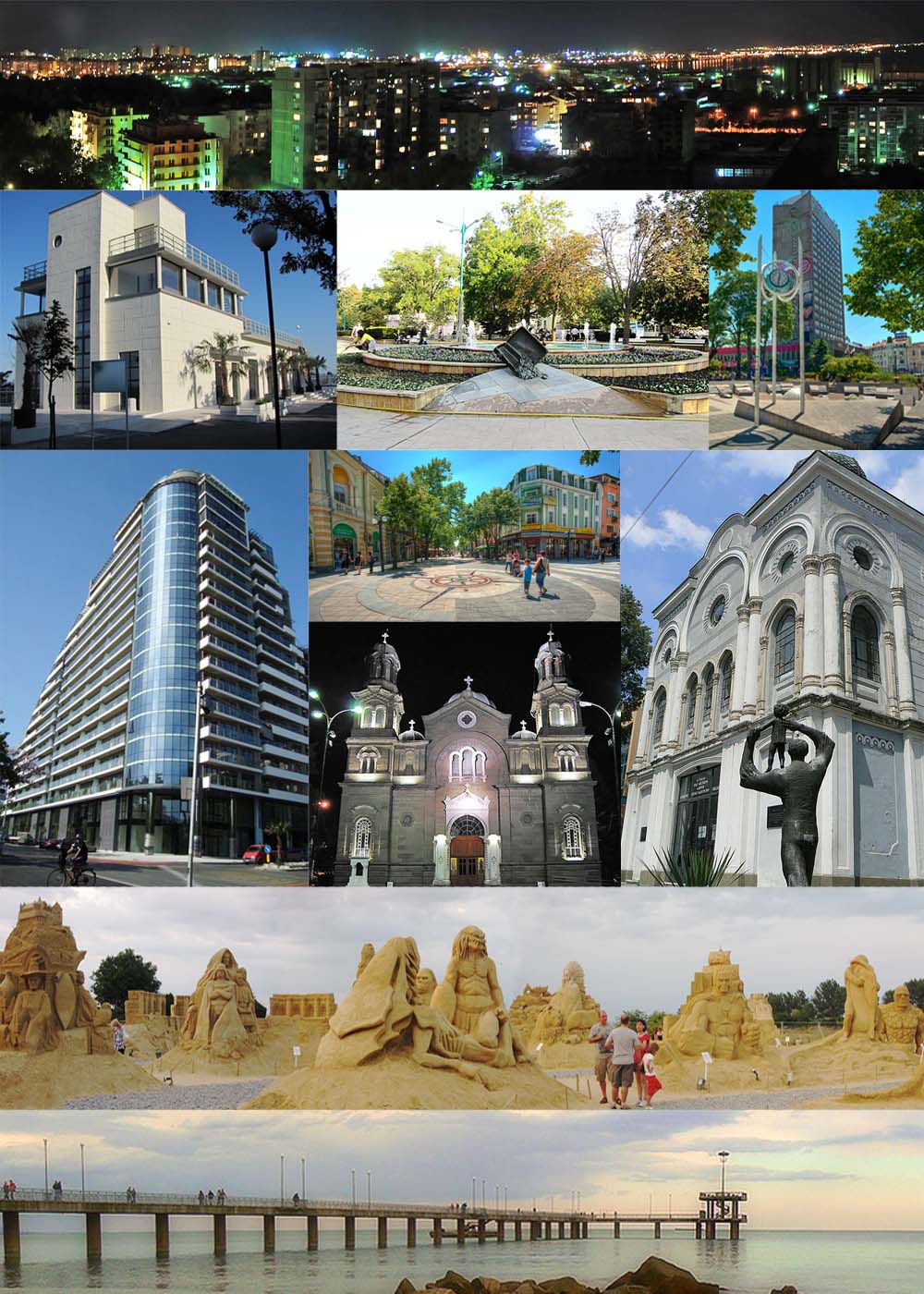
 Top to bottom, left to right: View of Slaveikov district at Night, Marine Casino Center in Burgas Sea Garden, A fountain in Tsaritsa Ioanna Square, View of Clock in Transportana shopping area, Panteona Complex Building, Bogorids Street, St. Cyril and Methodius Cathedral, Burgas Art Gallery, View of Burgas Sand Sculptures event in Sea Garden, The Pier at the Burgas Central Beach | |
 Flag  Coat of arms | |
| Nicknames: "The city of sea and lakes" "The city of the dreams" | |
  Burgas Location of Burgas | |
| Coordinates: 42°30′10.674″N 27°28′12.644″ECoordinates: 42°30′10.674″N 27°28′12.644″E | |
| Country | Bulgaria |
| Province (Oblast) | Burgas |
| Municipality | Burgas |
| Government | |
| • Mayor | Dimitar Nikolov (GERB) |
| Area | |
| • Total | 253.644 km2 (97.932 sq mi) |
| Elevation | 30 m (100 ft) |
| Population (2014-31-12) | |
| • Total |  202,694 (within city limits) 202,694 (within city limits) |
| • Urban |  277,922[1] 277,922[1] |
| Time zone | UTC+2 (EET) |
| • Summer (DST) | UTC+3 (EEST) |
| Postal codes | 8000–8034 |
| Area code | (+359) 56 |
| Website | Official website |

Burgas (Bulgarian: Бургас, pronounced [burˈɡas]), sometimes transliterated as Bourgas, is the second largest city on the Bulgarian Black Sea Coast in the region of Northern Thrace and the fourth-largest in Bulgaria after Sofia, Plovdiv, and Varna, with a population of 202,694 inhabitants, while 277,922 live in its urban area. It is the capital of Burgas Province and an important industrial, transport, cultural and tourist centre.
The city is surrounded by the Burgas Lakes and located at the westernmost point of the Black Sea, at the large Burgas Bay. LUKOIL Neftochim Burgas is the largest oil refinery in southeastern Europe and the largest industrial enterprise. The Port of Burgas is the largest port in Bulgaria, and Burgas Airport is the second most important in the country. Burgas is the centre of the Bulgarian fishing and fish processing industry.[2]
Names[edit]

A similar literal composition have the cities Burgos in Spain and numerous cities containing the Germanic burg "city" such as Hamburg. It is widely considered, including by the city's official website, that the name of the city is derived from the Latin word "burgus" as meaning a "tower", after a local ancient Roman travel post, which used to be in the area of today's Burgas Port. 15 centuries later, the settlement was mentioned by the Byzantine poet Manuel Phil as "Pyrgos" (Greek: Πύργος), a word identical in meaning with the Greek word for tower.[3][4] The name passed to Bulgarian through the Turkish Burgaz. There are several alternative explanations for the name's origin. By one of them, the city's name comes from Gothic name "baurgs" as meaning "signified consolidated walled villages".[5] According to Bulgarian prof. Kiril Vlahov, the name of the city comes from the Thracian word "pyurg" as meaning "fortification of wooden beams". It is also suggested that the name ultimately comes from the name of khan Burtaz (683-633 BC).
Geography[edit]
Topography[edit]
Burgas is situated at the westernmost point of the bay by the same name and in the eastern part of the Burgas Plain, in the east of the Upper Thracian Plain. Burgas is located some 389 kilometres (242 mi) from Sofia, 272 km (169 mi) from Plovdiv, and 335 km (208 mi) from Istanbul. To the west, south and north, the city is surrounded by the Burgas Lakes: Burgas, Atanasovsko and Mandrensko, which are home to several hundred bird species. Pan-European corridor 8 passes through the city,[6] the European routes E87 and E773, and the longest national rout I/6.
The St. Anastasia Island is a part of the city.
Climate[edit]
Burgas has a humid subtropical climate (Köppen climate classification Cfa) but with continental influences. The summertime in Burgas lasts about five months from mid-May until late September. Average temperatures during high season is 24 °C (75 °F). Summertime sea temperatures stay around 23–24 °C (73–75 °F) at sunrise and go up to 29–30 °C (84–86 °F) at dawn, averaging 26 °C (79 °F). Winters are milder compared with the inland part of the country, with average temperatures of 4–5 °C (39–41 °F) and below 0 °C (32 °F) during the night. Snow is possible in December, January, February and rarely in March; however, it can quickly melt. The highest temperature was recorded in June 2007, at 42.8 °C (109 °F) and the lowest at −21.6 °C (−7 °F) in January 1942.
RENT OR BUY
Popular movies
See more


RENT OR BUY
Currently trending movies


RENT OR BUY
Military and war movies
See more


RENT OR BUY
Venice Film Festival award winning movies
See more


RENT OR BUY
Action and adventure movies
See more


RENT OR BUY
OSCAR® nominated and award-winning movies
See more


Comments
Post a Comment